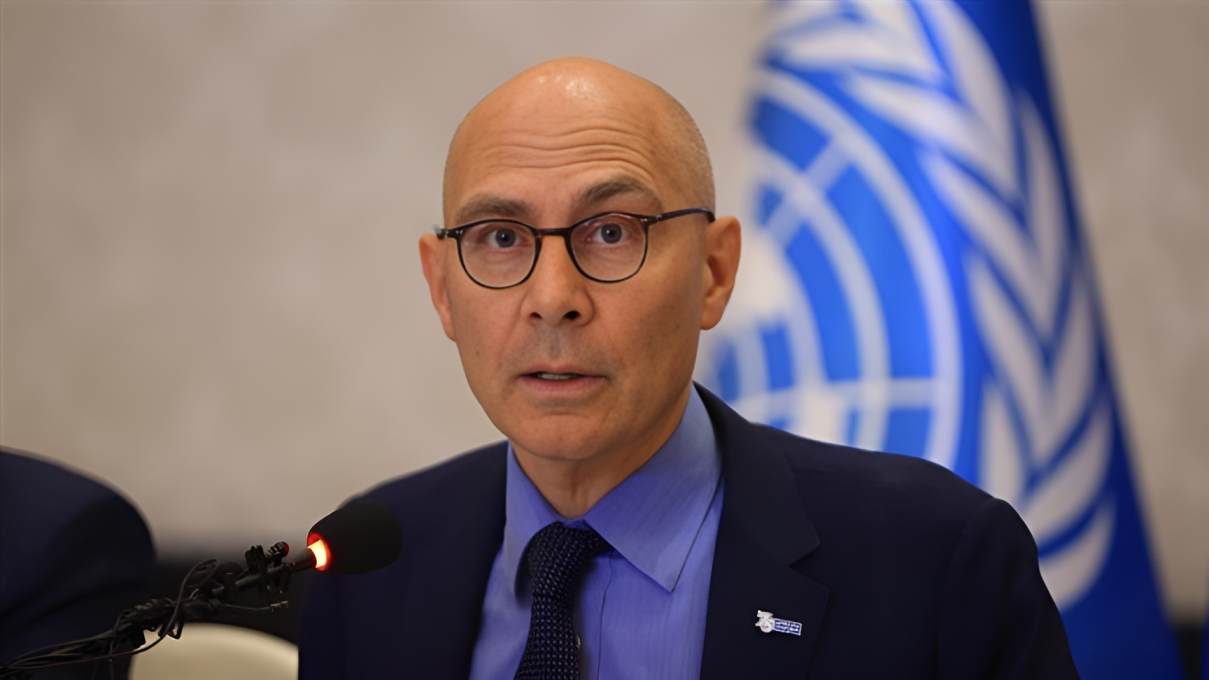
The UN Human Rights Chief Volker Türk has warned that violations of the laws of war are becoming normalised, as civilian suffering intensifies from Ukraine to Gaza and Sudan.
He urged states to prioritise human rights and justice in ceasefires and peace agreements and to strengthen accountability worldwide.
Speaking on Monday at the opening of the 61st session of the United Nations Human Rights Council, he said the world was witnessing “a fierce competition for power, control and resources at a rate and intensity unseen for the past 80 years”.
“People are feeling unmoored, anxious and insecure,” he said, adding that “the gears of global power are shifting, the consequences are not clear”.
Marking four years since Russia’s full-scale invasion of Ukraine, he described “four interminable and agonizing years” in which “civilian casualties have soared, and Russia’s systematic attacks on Ukraine’s energy and water infrastructure could amount to international crimes”.
“The fighting needs to end, and I urge a focus on human rights and justice in any ceasefire or peace agreement,” he said.
Beyond Ukraine, he highlighted “mass civilian suffering, from Sudan, to Gaza, to Ukraine, to Myanmar unfolding before our eyes”.
In Sudan, he said, “there needs to be accountability for all violations by all parties notably, the war crimes and possible crimes against humanity committed by the Rapid Support Forces in El Fasher”.
He warned that such atrocities must not be repeated in Kordofan or elsewhere and urged those with influence to act urgently to put an end to this senseless war.
On Gaza, he described the situation as “catastrophic”, saying “Palestinians are still dying from Israeli fire, cold, hunger, and treatable diseases”.
He added, “The aid allowed in is not enough to meet the massive needs,” and expressed concerns over ethnic cleansing in both Gaza and the West Bank.
In Myanmar, five years after the military coup, he said the awful conflict is claiming even more civilian lives, and the humanitarian situation continues to deteriorate.
Across many conflicts, he warned that “journalists, health and aid workers are targeted, in blatant violation of international law”, stressing, “These actions must not be allowed to harden into the new normal.”
He criticised what he described as a resurgence of domination and supremacy. “If we listen to the rhetoric of some leaders, what lurks behind it is a belief that they are above the law, and above the UN Charter,” he said.
“They claim exceptional status to pursue their own agenda at any cost. And why wouldn’t they try, when they are unlikely to face consequences?”
He also warned that a tight clique of tech tycoons controls an outsize proportion of global information flows, distorting public debate, markets, and even governance systems.
Despite the bleak assessment, he said people around the world were resisting from the ground up. “Women and young people especially are leading these movements,” he said, describing how communities were demanding basic living conditions, fair pay, bodily autonomy, self-determination, to be heard, to vote freely.
“Human rights are universal, timeless, and indestructible,” he declared.
Calling for stronger action, he urged states to be persistent objectors to violations of the law, by pursuing accountability, and by clearly denouncing these egregious crimes with consistency, and without exception”.
He also called for strengthening international accountability mechanisms, including the International Criminal Court, and announced plans to launch a “Global Alliance for Human Rights”.
“It will confront top-down domination with grassroots solidarity and support,” he said. “It will represent the quiet majority, who want a different world.”
Concluding his address, he said, “Human rights are not political currency, and they are not up for grabs. Our future depends on our joint commitment to defend every person’s rights, every time, everywhere.”































Comments
Sign in with Google to comment, reply, and like comments.
Continue with Google